




Celebrating 250 Years of USA – Vertical Conveying Proudly American
Vertical Conveying made in the USA and rooted in Yorktown
 As America celebrates 250 years, Ryson is proud to build Vertical Conveying Solutions in the US… Yorktown VA to be exact. That location connects us to one of the most historically significant regions in the country. The Ryson facility is less than 6 mi from where British General Charles Cornwallis surrendered his army of about 8,000 men to General George Washington in 1781.
Yorktown helped shape America’s independence. And today, it also helps shape American manufacturing. From this Virginia facility, Ryson designs, builds, tests, and supports Spiral Conveyors for operations across North America.
For manufacturers, warehouses, and distribution centers, that matters.

Why does USA-made equipment matter?
Because buying a Ryson Spiral Conveyor supports more than domestic manufacturing. It also reduces project risk, shortens timelines, and strengthens long-term service support.
Domestic manufacturing helps Ryson customers avoid many global supply chain challenges. Shorter transit distances reduce exposure to port congestion, customs delays, and overseas freight disruptions. As a result, projects can move with greater confidence from order to installation.
Ryson also stocks and ships critical spare parts from its U.S. facility. That matters when uptime drives revenue. Faster parts availability can reduce downtime and help operations recover quickly. At Ryson we generally ship our spare parts within 24h of getting an order from our customers, because we know that time is money.
Freight costs also play a role. Heavy industrial equipment can cost significantly more to ship across oceans. Domestic delivery helps control logistics costs and simplifies coordination.
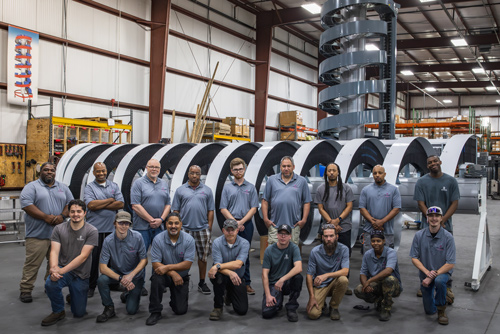
Ryson’s American manufacturing advantage extends further. Each Spiral Conveyor reflects american heavy-duty craftsmanship, precise engineering, and rigorous quality control. The Ryson team builds every Spiral to match application requirements, facility constraints, and integration needs.
Ryson’s proprietary rolling friction design also helps reduce wear. This low-maintenance approach supports long service life and a lower total cost of ownership. In many facilities, it also helps cut energy demand while maintaining reliable throughput.
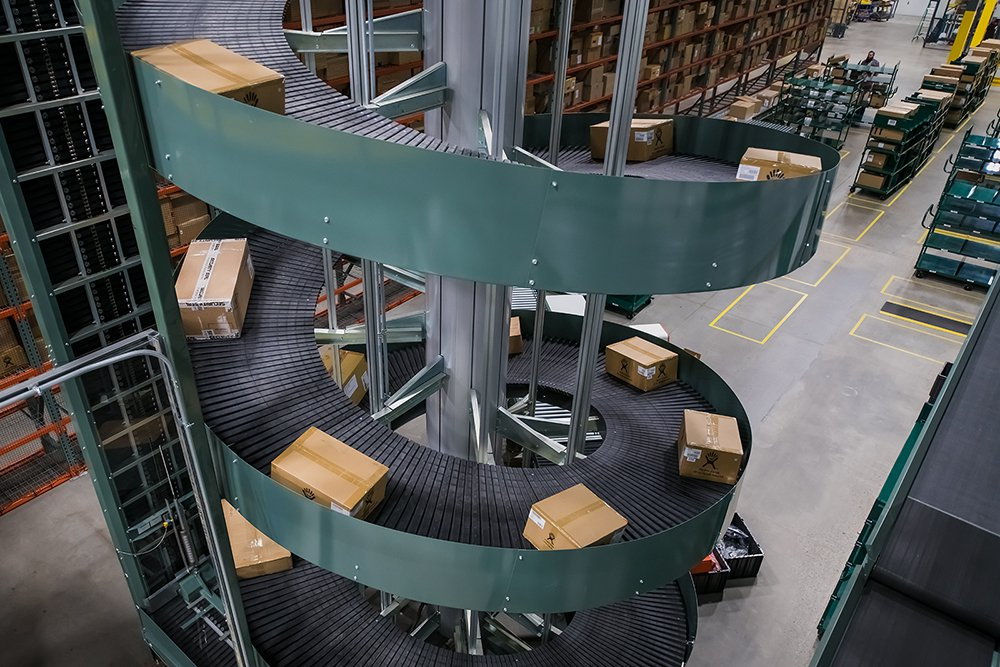
Space savings create another advantage. Ryson Spiral Conveyors move products vertically while using a compact footprint. That helps facilities recover valuable floor space without sacrificing flow.
What makes Ryson support different?
Customers can work directly with the people who understand the equipment best. Ryson offers access to engineering expertise, factory testing, field service coordination, and technical support across American time zones.
That direct collaboration simplifies custom modifications, site planning, and system integration. It also removes the communication friction that can come with overseas sourcing.
America’s 250th anniversary makes us incredibly proud and grateful for our team, our country and our mission. It encourages investment in what comes next. For Ryson, the future of material handling still starts with strong engineering, dependable support, and American-made quality.
Buying a USA-made Ryson Spiral is a proud choice. More importantly, it is a smart business decision.
Invisible MVP: Inside the Massive Supply Chain Behind the 2026 FIFA World Cup
When the 2026 FIFA World Cup was kicked off, the eyes of the world will focus on the pitch. Millions of fans fill world-class stadiums across the United States, Mexico, and Canada, while billions more tune in from home.
But long before the first goal is scored, an entirely different kind of team has been working around the clock: the global supply chain.
Co-hosting a 48-team, 104-match tournament across three massive nations is an unprecedented logistical feat. FIFA’s official logistics partners must manage the movement of over one million pounds of equipment, utilizing more than 5,000 specialized vehicles and one million square feet of dedicated warehouse space.
Behind the scenes, consumer goods manufacturers, food and beverage plants, and automated distribution centers are experiencing the ultimate stress test. Here is a look at the staggering numbers and supply chain demands fueling the world’s biggest sporting event.

The Food & Beverage Industry: Cans > Bottles

The demand for refreshments during a World Cup summer is astronomical, driving a projected $40.9 billion in additional global GDP. Host cities are expecting hundreds of thousands of international visitors daily. Single-day fan expenditures are averaging $200 to $400 per person on hospitality and dining.
-
Can Beverages: The aluminum beverage-can industry entered the year operating at a blistering mid-90% capacity in North America, heavily driven by World Cup forecasting. Historically, major sporting tournaments drive massive trade-ups from glass bottles to aluminum cans due to stadium safety rules and consumer convenience. Beverage brands are seeing mid-to-high double-digit volume gains in can production.
-
Shifting Product Mixes: It’s not just traditional beer flying off the shelves. Production lines have rapidly shifted to accommodate a huge surge in ready-to-drink (RTD) cocktails, sports drinks, and non-alcoholic beers, which are dominating new product formats.
For food and beverage manufacturers, this requires incredible floor flexibility. Production facilities must quickly pivot between packaging sizes. Examples can be budget-friendly mini-cans or promotional finishes. All these different types of products need to be conveyed without causing a bottleneck in the facility.
Sports Wear, Apparel, and Retail: The Fanatics & E-Commerce Surge
The global sports apparel market is valued at a staggering $233.81 billion, fueled heavily by jersey drops and tournament merchandise. Meanwhile, the licensed sports merchandise market alone is sitting at $40.5 billion. Apparel accounts for nearly half (46.5%) of that massive total.
Managing this inventory is a highly synchronized dance:
-
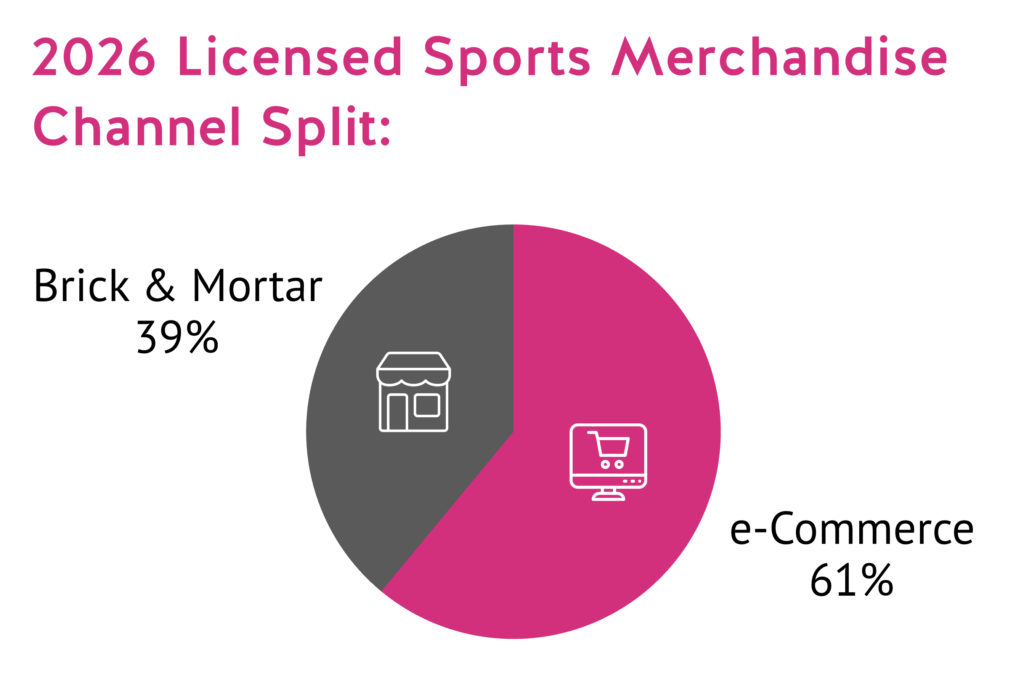
The E-Commerce Dominance: A massive 61% of all tournament distribution is moving through online channels. E-commerce distribution centers are working at peak capacity to fulfill online jersey orders before matches begin.
-
Stadium Retail: In an unprecedented move, retail giant Fanatics took over on-site retail operations for all 104 matches across the 16 host cities. This requires real-time demand forecasting and flexible cross-border logistics to ensure that when a specific country advances to the next round, their jerseys are instantly stocked at the stadium the next morning.
Keeping the Flow: How Ryson Spirals Support the Supply Chain
To handle record tournament volumes without grinding to a halt, manufacturing plants and fulfillment centers rely on high-capacity automation. This is where Ryson spiral conveyors serve as the ultimate defensive play for facility layouts.
Whether moving heavy beer cans, secondary packaging boxes, or polybags filled with jerseys, floor space is at a premium. Ryson’s continuous-flow vertical solutions take product lines straight up—reclaiming up to 75% of the floor footprint wasted by sprawling, traditional incline conveyors.
Unlike systems prone to product slippage or bunching, spirals maintain a smooth, uniform tempo at speeds up to 200 feet per minute. This rolling friction design ensures thousands of products ascend or descend without interruption—much like a world-class midfield keeping the ball in continuous motion. By eliminating bottlenecks, maximizing overhead space, and minimizing downtime, Ryson spirals ensure the global supply chain never misses a play.
Get in touch with Ryson and learn more about the benefits of Spiral Conveyors:
Contact | Our YouTube Channel | Follow us on Linkedin!
Vertical Conveying ROI: What CFOs Really Measure Before Investing
 Vertical Conveying ROI depends on more than equipment cost. Ryson systems maximize ROI by reducing space, energy, and operational expenses.
When companies evaluate Vertical Conveying ROI, the conversation often starts with throughput. However, CFOs and financial leaders look deeper. They focus on total cost, long-term savings, and how efficiently a system uses available space.
This shift in perspective explains why Ryson Spiral Conveyor solutions consistently deliver strong financial performance across many industries and regions.
 What drives Vertical Conveying ROI?
First, consider total cost of ownership. This includes installation, energy consumption, maintenance, and lifespan. Ryson systems reduce each of these factors. Their compact vertical design lowers installation complexity and minimizes facility modifications. In high-cost regions where real estate drives decisions, this creates immediate financial advantages.
Energy efficiency also plays a major role. Modern components and optimized system design reduce power consumption over time. This becomes especially important in large distribution centers where conveyors operate continuously.
Next is space utilization, a critical but often overlooked metric. Vertical Conveying ROI improves significantly when unused overhead space becomes productive. Ryson Spiral Conveyor systems allow facilities to increase throughput without expanding their footprint. This benefit proves especially valuable in urban and coastal markets where expansion costs remain high.
How quickly does the system pay for itself?
Payback period remains a key concern. Ryson systems accelerate ROI by reducing labor dependency and simplifying product flow. Fewer transfer points and a streamlined layout improve efficiency while lowering operational complexity. As a result, companies often see faster returns compared to traditional conveying methods.
Reliability also protects ROI. Downtime introduces risk and unexpected cost. Ryson equipment is built for continuous operation with minimal maintenance. This consistency ensures predictable performance and stable financial outcomes. Ryson is also equipped with a full inventory of spare pares and our service team is at the ready, minimizing the risk for extended down time. Also available are spare parts kits tailored to your Spiral model, and Ryson service contracts.
What about long-term flexibility?
Scalability strengthens Vertical Conveying ROI over time. Markets evolve, especially in e-commerce and fulfillment. Ryson solutions adapt to changing throughput demands without requiring major redesign. This flexibility protects capital investments and supports future growth. Ryson Spirals can be field modified to adapt to a production line change, further enhancing the life of your investment.
Finally, sustainability continues to influence financial decisions. Energy-efficient vertical conveying solutions help reduce operating costs while supporting ESG initiatives. This alignment adds another layer of value to the investment.

The takeaway
Vertical Conveying ROI improves when systems reduce costs, maximize space, and deliver reliable performance. Ryson achieves all three. By combining efficient design with proven durability, Ryson Spiral Conveyor solutions consistently rank among the strongest investments in material handling.
In today’s competitive landscape, the right vertical conveying solution does more than move products. It drives measurable financial results. Watch our Corporate Video
MHI, MHEDA, WERC – Why Industry Associations Keep Us Moving Forward
In warehousing and logistics, nobody operates in a vacuum. For us at Ryson, building spiral conveyors is only half the job; the other half is understanding how our equipment is being integrated into the bigger picture of your operations. That is why we stay deeply involved with associations like MHI (including WERC) and MHEDA.
These groups bring manufacturers, distributors, and end-users together under one roof. They give us a direct line to the daily challenges you face on the floor, helping us build better machinery based on real feedback.
Our active presence within MHI extends deep into specialized groups like the Conveyor & Sortation Systems (CSS) and the Solutions Community, alongside the Young Professionals Network (YPN) and the Marketing Professionals (MPro) communities.
MHI’s new interactive Digital Warehouse
 A great example of this collaboration is MHI’s new interactive Digital Warehouse platform. It is a 3D animated walkthrough of a functional facility, showing how different technologies handle product flow.
We are excited to see that Ryson spirals are part of the animation (Manual Picking). You can check out the tool to see exactly how our vertical conveyors fit into a modern facility layout to save floor space and keep lines moving.
You can spot the Ryson spirals operating in the multi-tier pick module and sorter induction zones.
One is positioned right where the multi-level mezzanine lines need to merge with the main takeaway conveyors. Instead of using a massive incline belt that would cut right through the middle of the floor space, the animation shows our compact vertical spiral smoothly lowering picked totes and cartons from the elevated platform down to the main floor level.
 Why do so many distribution and fulfillment centers rely on Ryson?
It comes down to space and flexibility.
Industrial real estate prices keep climbing. Companies must look up rather than out. Ryson spirals have a small footprint. They let facilities use vertical space instead of wasting floor area on long, traditional incline belts.
This gives brownfield projects a massive advantage. When you modernize an existing building, you cannot move the walls. Still, you have to upgrade old equipment to use the available space. Our modular spirals fit right into tight, established layouts. This makes it easy to add high-capacity automation without rebuilding the entire line.
An Example
This video provides a visual demonstration of how Ryson’s multi-level high-capacity spiral conveyors operate dynamically in multi-tier warehousing and order picking applications, echoing the concepts shown in the new Digital Warehouse platform:
The Hidden Cost of Downtime and How Spare Parts Can Help
 Why Spare Parts and Preventative Maintenance can Help Reduce the Hidden Cost of Downtime.
Bottom line: A small investment in spare parts and proactive maintenance can prevent massive downtime losses and protect throughput. Unplanned downtime is no longer just a maintenance issue. It directly impacts revenue, customer commitments, and operational stability. In some industries, downtime can cost tens of thousands per hour, and in others, millions.
So the question becomes simple: how do you reduce both the frequency and duration of downtime? The answer lies in combining two strategies—on-hand spare parts and preventative maintenance.
Why Spare Parts Matter More Than You Think
When equipment fails, the clock starts immediately. However, most delays do not come from repair work. They come from waiting on parts. On-hand critical spare parts eliminate that delay. They reduce mean time to repair by removing procurement, shipping, and approval bottlenecks.
For systems like a Ryson Spiral Conveyor, this matters even more. Spirals often act as throughput enablers. If one stops, the entire line can back up quickly. Even a short delay can ripple across operations, causing missed shipments and lost productivity. That is why a curated spare parts kit is not optional. It is operational insurance.
 Preventative Maintenance Reduces Failures Before They Happen
Spare parts solve recovery time. Preventative maintenance reduces how often failures occur. Predictive and preventative programs can reduce downtime by up to 45% and eliminate most breakdowns. These programs identify wear early, allowing teams to plan repairs instead of reacting to failures. That shift improves scheduling, reduces emergency labor, and protects throughput.
For conveying systems, simple routines make a measurable difference. Regular chain inspections, tension checks, and sensor validation keep systems running reliably.
The Financial Case Is Hard to Ignore
Many companies hesitate to carry inventory due to cost. However, the math tells a different story.
Inventory carrying costs typically range from 20–30% annually. Yet a single avoided downtime event can offset that cost in minutes. For example, a modest spare parts kit may pay for itself if it prevents just a few minutes of downtime in a high-throughput operation. That is a compelling return for any operation focused on efficiency.
 Why Ryson Systems Strengthen the Strategy
Ryson Spiral Conveyors already deliver reliable, space-saving performance. When paired with a structured spare parts and maintenance program, they become even more valuable.
Their modular design, integrated safety controls, and defined maintenance points make it easier to plan service and minimize disruption. More importantly, their role in system flow means uptime directly protects overall productivity. Contact our service team!
Q: What Is the Best Approach to Battle the Hidden Cost of Downtime?
A: Combine critical spare parts with preventative maintenance. This approach reduces downtime risk, improves operational predictability, and protects revenue.
How Ryson Turns Commitment to ESG Into Real-World Impact
Ryson’s Commitment to ESG Starts with Responsibility
Environmental, Social, and Governance, commonly known as ESG, has become a major focus across manufacturing and supply chain industries. ESG measures how companies manage environmental impact, support people and communities, and maintain responsible business practices. Customers, employees, and business partners increasingly expect manufacturers to operate sustainably while creating long-term value.
For companies in material handling and automation, ESG is no longer optional. Energy efficiency, operational sustainability, employee engagement, and community involvement now influence purchasing decisions and business relationships. Companies want partners who can help lower environmental impact while supporting responsible growth.
 At Ryson, ESG is not limited to a single initiative. It influences how we design our equipment, support our customers, and invest in our local communities.
From an environmental perspective, Ryson focuses on delivering efficient conveyor solutions with a low total cost of ownership. Ryson Spiral Conveyors already help facilities reduce building footprints by maximizing vertical space. Advanced motor technology now pushes that efficiency even further.
The result is a conveyor solution that helps customers reduce energy consumption, lower maintenance requirements, and improve operational efficiency. Businesses can move products more sustainably without sacrificing throughput or reliability.
However, ESG extends beyond equipment performance. The social component of ESG focuses on people, community engagement, and positive local impact. Ryson believes strong businesses should actively support the communities where employees live and work.
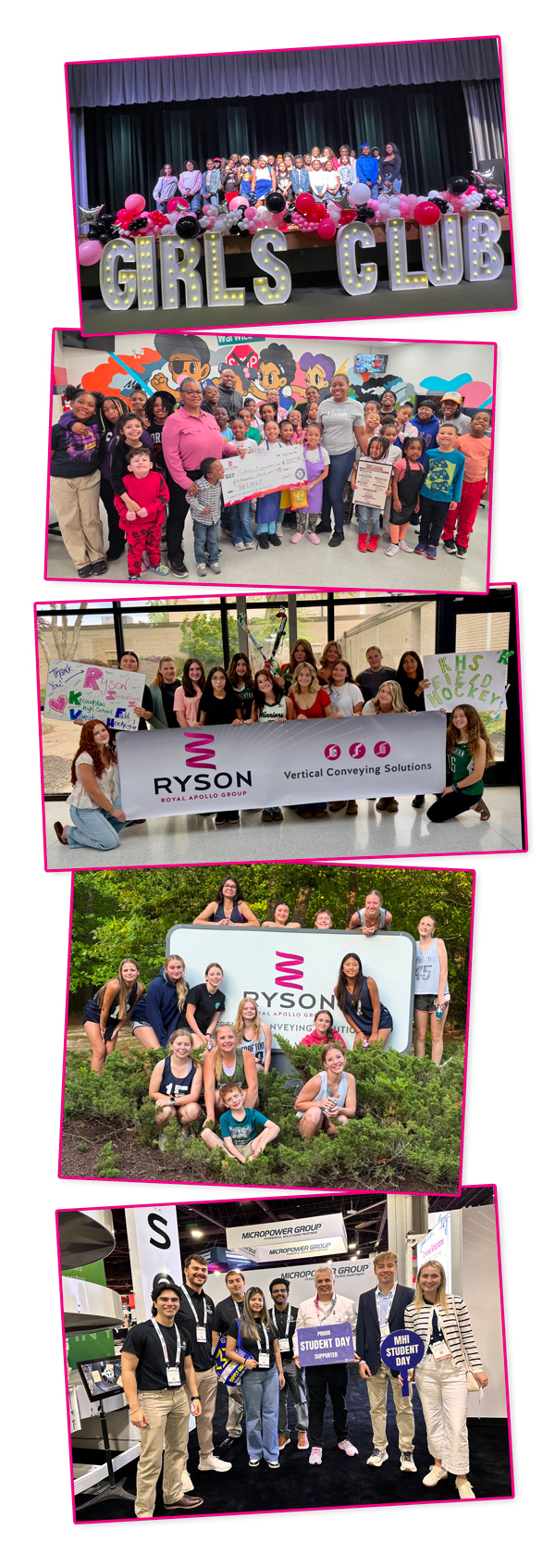
That philosophy inspired the Ryson Sponsorship Program. The initiative supports local clubs and organizations where employees volunteer and participate. The program encourages employee engagement while strengthening community relationships and supporting meaningful local causes.
The first half of 2026 highlighted several impactful examples.
Lucy Johnson received sponsorship support for the Girls Mentor Group. The organization helps young girls build confidence, develop life skills, and access mentorship opportunities.
Ashley Simpson’s Youth Spring Break Program provided meals, activities, and supplies for children in Newport News. The program created a safe and engaging environment for local youth during school break.
Ryson also supported the Kecoughtan High School Girls Field Hockey team through funding for uniforms, transportation, and equipment.
In addition, Bill Keane volunteered with students attending Modex in Atlanta through an MHI-organized learning initiative. The experience introduced students to modern material handling technologies while encouraging future industry involvement.
These efforts reflect Ryson’s broader commitment to ESG. Sustainable business practices involve more than reducing energy use. They also require investment in communities, employee engagement, and responsible long-term partnerships.
At Ryson, commitment to ESG remains central to delivering value for customers, employees, and communities alike.
Royal Apollo Group Joins Interroll Holding AG
The Netherlands-based vertical conveying company Royal Apollo Group announces its acquisition by Interroll Holding AG, gaining a global platform, unlocking worldwide reach and strengthening its position as a material handling solutions provider.
The Netherlands, May 8, 2026 — Royal Apollo Group, a Netherlands-based provider of vertical conveying, logistic and baling solutions, today announced that it has been acquired by Interroll Holding AG, a global leader and provider of material handling solutions. The transaction, which signed and closed simultaneously on May 7, 2026, marks a defining milestone in Royal Apollo’s nearly 180-year history and opens a new chapter of global growth.
By joining Interroll, Royal Apollo gains immediate access to a substantially broader global network that it could not have established independently. Interroll’s presence across international markets and verticals, combined with its established infrastructure for lifecycle services, creates a platform from which Royal Apollo’s technology can reach customers and system integrators worldwide who would previously have been beyond the company’s direct reach.
“I’m excited to share that Royal Apollo Group is joining Interroll. This is a big move and a carefully made decision that marks the next chapter in our 6th generation family business. It gives us access to Interroll’s much wider global network, an opportunity we would not have had if we remained independent. Our products and services complement Interroll’s offering well, and together we will combine our strengths to align product development, operations, and go-to-market activities over time. This new chapter is something I’m very proud and excited about.”
— Claudia van den Pol, CEO and Owner of Royal Apollo Group

The acquisition brings a strategically complementary fit. Interroll’s conveying portfolio, augmented by Royal Apollo’s spiral conveyor technology, creates a more complete offering in the vertical conveying market while strengthening lifecycle services and spare parts capabilities for customers globally.
The two businesses will work to integrate product development, operations, and go-to-market activities over time, with a focus on making Royal Apollo Group’s product range accessible to Interroll’s existing customers and system integrators, as well as new customers across markets where Interroll already operates.
With this acquisition, we add Royal Apollo Group’s spiral conveyor technology to Interroll’s conveying portfolio, closing a gap in our offering and strengthening our lifecycle services and spare parts business. The businesses are complementary, and we will focus on integration and making this product range available to our customers and system integrators worldwide as well as new customers that we will be able to reach thanks to this move”.
— Markus Asch, CEO of Interroll
Royal Apollo as a company will remain, including the team, product quality, and commitment to customer relationships. Claudia van den Pol also remains the CEO of the company. For Royal Apollo the key improvement lies in the depth and geographic reach of the service and spare parts infrastructure behind the products, driven by Interroll’s Global Lifetime Service capabilities.
Royal Apollo Contact
Netherlands: Bettina de Vries · bs@apollobv.com
International: Amanda Hawlik · ah@apollobv.com
About Royal Apollo Group
Royal Apollo Group is a global provider of spiral conveyor, logistic systems and baling solutions, with nearly 180 years of heritage. Headquartered in the Netherlands, the Group operates manufacturing facilities in the Netherlands, the United States (Ryson), and Thailand, supported by worldwide sales & service. Royal Apollo Group serves customers across the material handling and packaging industries with reliable, space-efficient, and scalable solutions.
About Interroll
The Interroll Group is the leading global provider of material-handling solutions. The company was founded in 1959 and has been listed on the SIX Swiss Exchange since 1997. Interroll provides system integrators and OEMs with a wide range of platform-based products and services in these categories: Rollers (conveyor rollers), Drives (motors and drives for conveyor systems), Conveyors & Sorters, as well as Pallet Handling (flow storage systems). Interroll products and solutions are used in express and postal services, e-commerce, airports, the food & beverage industry, fashion, automotive sectors, and many other industries. Among the end users are leading brands such as Amazon, Bosch, Coca-Cola, DHL, Nestlé, Procter & Gamble, Siemens, Walmart, and Zalando. Headquartered in Switzerland, Interroll has a global network of 36 operating companies with sales of CHF 514.2 million and around 2,400 employees (average number of employees (FTE) in 2025).
Interroll Investor Contact
Markus Asch│CEO
Via Gorelle 3 │ 6592 Sant’Antonino │ Switzerland
+41 91 850 25 24
investors.relations@interroll.com
Heinz Hössli│CFO
Via Gorelle 3 | 6592 Sant’Antonino | Switzerland
+41 91 850 25 24
investors.relations@interroll.com
www.interroll.com
Ryson at MHEDA Annual Convention 2026: Vertical Conveying That Drives ROI

The MHEDA Annual Convention brings together the material handling industry’s decision-makers, and Ryson will be there at Booth 3 to talk real solutions and real ROI.
Every year, the MHEDA Annual Convention gathers distributors, manufacturers, and service providers who shape the future of material handling. It is not just another trade event. It is where strategy meets execution. Leaders attend to solve operational challenges, strengthen partnerships, and uncover technologies that drive growth.
So why does this event matter? Because the audience is highly focused. Attendees include executives, operations leaders, and sales teams who influence purchasing decisions and long-term investments. They are not browsing. They are looking for answers.
That is where Ryson fits in.
At Booth 3, Ryson will showcase how Vertical Conveying Solutions improve throughput, reduce footprint, and deliver measurable ROI. In today’s environment, companies need more than equipment. They need systems that perform under pressure, scale with demand, and align with sustainability goals.
Ryson Spiral Conveyors address these needs directly. They optimize space in crowded facilities. They reduce energy consumption with advanced drive technologies. And they simplify material flow in industries ranging from e-commerce to food and beverage.
For attendees, the value is simple. You can walk up to Booth 3 and have a real conversation about your operation. No fluff. Just practical insights on how to move products more efficiently and cost-effectively.
What questions can you answer at Booth 3?
 How can I increase throughput without expanding my footprint?
What is the ROI of Vertical Conveying compared to traditional methods?
How do I reduce energy costs while improving system reliability?
Ryson’s team will be ready with answers backed by experience, engineering expertise, and proven installations worldwide.
The MHEDA Convention also offers a broader advantage. It creates space for networking, learning, and strategic thinking. When you combine that with direct access to solution providers like Ryson, the result is a high-impact event that drives real business outcomes.
If you are attending the 2026 MHEDA Annual Convention, make Booth 3 a priority stop. The conversation you start there could shape your next operational upgrade.
Beyond Equipment: Ryson’s Dedication to Customer Support
Service That Sets the Standard: Ryson’s Commitment to Customer Support
Bottom line: Ryson stands behind every solution with responsive service, collaborative support, and long-term customer commitment.
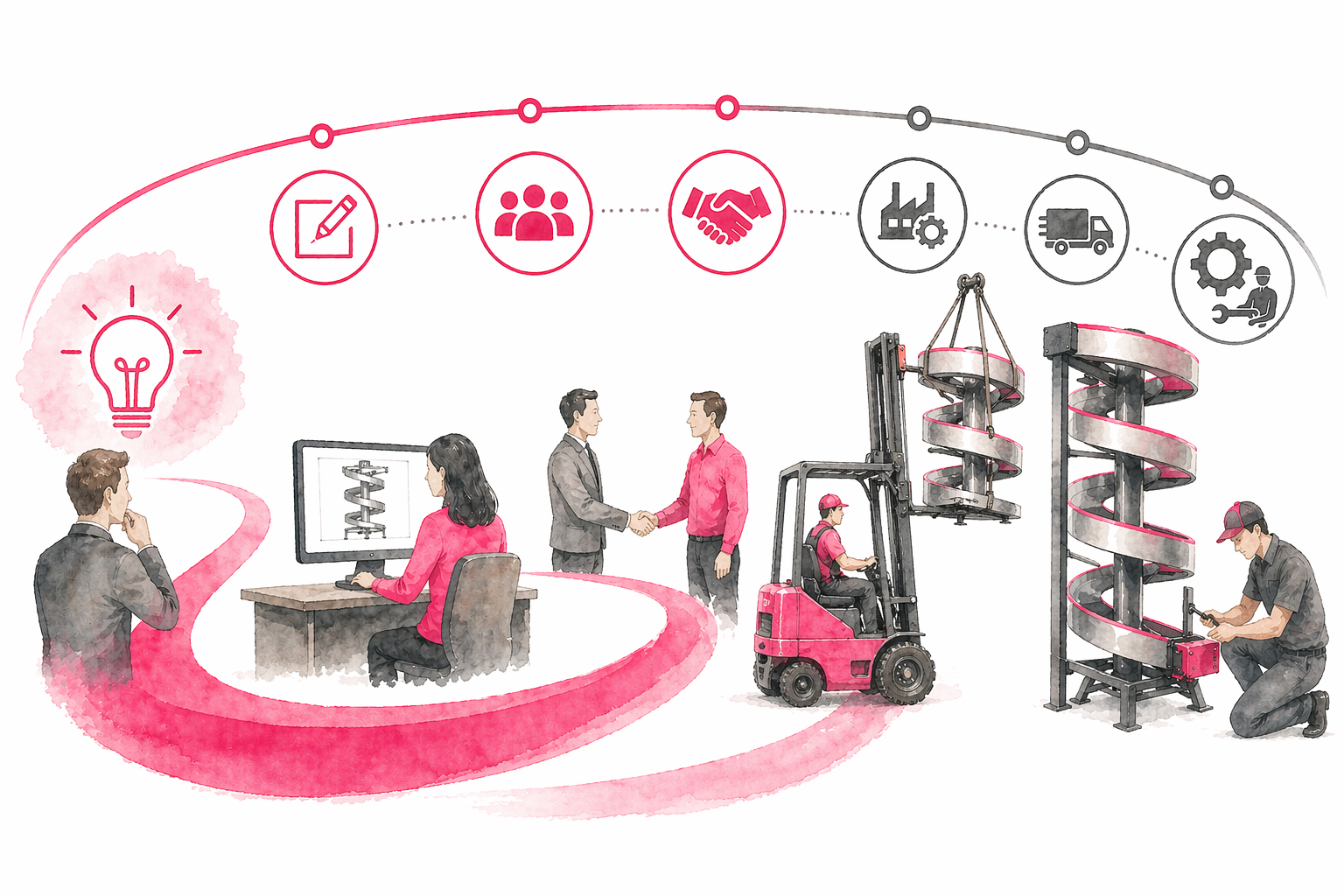
At Ryson, service does not begin after installation. It starts with the first conversation and continues throughout the life of your system. This dedication ensures every Spiral Conveyor and Bucket Elevator performs reliably, day after day.
How Does Ryson Deliver True Customer Support?
Customers often ask: What makes Ryson different? The answer is simple—consistent, proactive support.
First, our team approaches every project with a cooperative mindset. Our engineers work directly with customers to develop application-specific solutions. This collaboration ensures each system aligns with operational goals and real-world conditions. Next, we prioritize speed and accuracy. Fast RFQ turnaround keeps projects moving forward. Our team delivers detailed, dependable proposals without delay, helping customers make informed decisions quickly.

Support That Extends Beyond Installation
Many companies consider installation the finish line. Ryson sees it as the starting point. Our dedicated service team remains actively involved to support ongoing performance. They troubleshoot issues, provide technical guidance, and ensure minimal disruption to operations. When parts are needed, we respond quickly to keep systems running.
Equally important, we invest in your team. Ryson provides hands-on training for maintenance staff at installation sites. This training builds confidence and helps reduce long-term downtime by keeping the spirals running.

Why Does Dedicated Service Matter?
Reliable equipment depends on more than design. It depends on support, responsiveness, and expertise.
What Are Customers Saying?
“My Go-To for Case and Mass Flow Spirals.” – Christopher Cunningham, owner, C3 Packaging Partners Inc.
“Always a big fan one of the best most optimal units brought to the industry continuing to be a powerhouse” – Integrator Project Engineer
“I have 20 plus units in the field across multiple industries and customers. Every one of those projects, Ryson has been a pleasure to work with. Proposals are provided in a timely manner. Deliveries arrive on schedule and the installations went in without any drama or issues. I love selling your equipment so much that I even pulled the roof off one of my customers facilities to get the spiral into the building. Once the units are installed, I have virtually no maintenance issues or breakdowns. One of my older units was put in around 2010 and we just did a complete rebuild. That is saying something because this customer had no maintenance team and never serviced it. That is not what we would recommend, but what a great track record. I am looking forward to selling the next 20 plus units!” – Ivar London, Sales Engineer, Advanced Equipment Company
“Ryson has been extremely supportive on all sides of the sales process from assisting with challenging layouts, to availability to answer questions during install and extremely supportive on post installation with our end users. — Ryson creates a robust product that durable and yet easy to install. There is a lot of design intent behind much of their product from full length clear return panels so that you can see their chain stretch gauge to integration of induction sensors to measure motor kick back and loose chain sensing to name a few stand out features.” – Integrator Systems Engineer
“Your role as a true partner has greatly contributed to the success of our business. Ryson has consistently provided us with the most reliable, bulletproof equipment in the industry, and you folks have bailed me out of more than one self-inflicted screw up! It has been a pleasure working with each and every one of you, I truly appreciate your support over the years.” Jim Yates – Innovative Handling Systems
The Ryson Difference
Service at Ryson is not reactive. It is intentional and ongoing. We know that a happy customer is a repeat customer, therefore we make customer support part of our ethos. Ryson partners with customers from concept through operation. We respond quickly when challenges arise. And we also stay committed to long-term success.