



 Dust, Spillage and contaminants may seem unavoidable in bulk material handling. However, your vertical conveying design determines how much dust you actually create. It also determines how much escapes into your facility.
Every transfer point, bucket fill, and discharge creates an opportunity for spillage. Traditional vertical systems often amplify the problem. Open bucket elevators leak dust through gaps and poorly sealed doors. Improvised chutes create turbulence that throws fines into the air. Steep belts and vertical screws overflow at the inlet can generate chronic dust clouds. Adding a dust collector to a leaky system rarely solves the root issue.
As a result, operators fight constant cleanup, product loss, and compliance concerns. ATEX and NFPA standards demand more than surface fixes. They require a fundamentally contained design.
A containment-first approach starts with a fully enclosed product path. It reduces transfer points and controls how product enters and leaves the system. Just as important, it handles material gently to prevent breakage in the first place.
Where Do Traditional Designs For Vertical Bulk Conveying Fall Short?
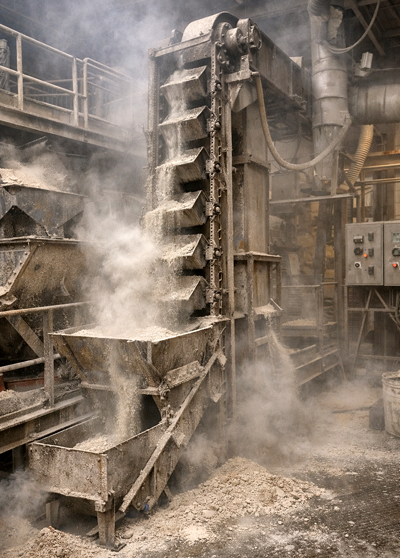 A lot of legacy equipment was never designed with modern dust and explosion standards in mind. Typical weak points include:
-
Open or partially enclosed bucket elevators
Wide gaps at infeed and discharge, poorly sealed inspection doors and unsealed casings allow dust to escape and settle on surrounding structures. -
Improvised transfer chutes
“Homemade” chutes between horizontal and vertical sections often lack proper sealing, skirting or stilling zones. Impact and turbulence throw fines into the air rather than containing them. -
Vertical screw or belt conveyors with open inlets
When bulk solids are fed aggressively into a vertical screw or steep belt, material can overflow, leading to chronic spillage and dust plumes at the feed point. -
Aging equipment upgraded only with external dust collectors
Adding a dust collector to a fundamentally leaky, poorly sealed elevator casing may reduce airborne dust, but product loss and build‑up often remain.
These solutions may move the product, but they typically make it harder to keep floors clean, comply with ATEX/NFPA, and maintain a safe working environment.
A containment‑first approach to vertical conveying focuses on a fully enclosed product path, controlled filling and discharge, and reduced transfer points. Well‑sealed casings, guided product flow and compact vertical footprints help minimize both dust generation and escape paths. Service‑friendly access is critical, too: if doors and panels are difficult to use, cleaning and inspection get skipped, and build‑up turns into a safety and reliability issue.
This is where modern enclosed bucket elevator designs, like Ryson’s, come into play.

How Do Enclosed Bucket Elevators Help?
A continuous, well‑sealed casing around the material stream keeps dust and fines where they belong: inside the system. Gentle bucket filling and discharge reduce product degradation and the creation of fines. By combining true vertical conveying with a compact footprint, these elevators often eliminate multiple transfer points and long inclined runs that would otherwise generate spills and dust at each change of direction. And because the system is enclosed by design, integrating ATEX/NFPA measures such as explosion vents and isolation devices becomes more straightforward.
Enclosed bucket elevator designs, like the Ryson Bucket Elevator become a containment system themselves, instead of treating dust as an unavoidable side effect. Here’s a breakdown of how they support your operation:
-
Fully enclosed casings
Continuous casings with tight flanges, properly gasketed panels and well‑designed inspection doors drastically limit the escape paths for dust and fines. -
Gentle product handling
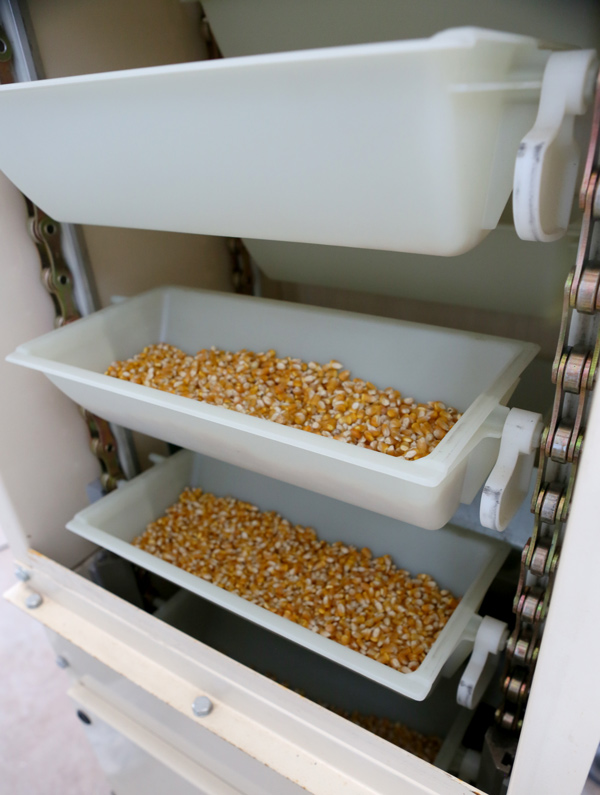
Carefully engineered bucket filling and discharge reduces product breakage as seen in scooping buckets and screw transfers: Whereas our Gentle handling pendant buckets in turn reduce the generation of dust and unusable product.
-
Compact, vertical footprint
With a true vertical conveying path, you can often eliminate multiple transfer points and long inclined runs that otherwise create spills and dust at each change of direction. -
The Ryson Bucket Design features a pendant traveling system, where the buckets travel while maintaining orientation preventing accidental spillage
-
A closed design makes it easier to implement ATEX/NFPA measures such as explosion vents, sensors and isolation devices where required.
The result is not only a cleaner installation, but also less product on the floor, fewer cleanup hours and a safer working environment around the elevator.
 What sets the Ryson Bucket Elevator apart?
The Ryson Bucket Elevator is designed from the ground up with containment, gentle handling and safety in mind. Its fully enclosed housing, tightly sealed inspection doors and guided bucket path help keep dust and fines inside the system instead of in the surrounding area, which directly supports cleaner operation and easier compliance with ATEX and NFPA requirements.
The gentle filling and discharge of the buckets reduce product breakage, lowering the amount of fines generated in the first place and protecting sensitive or high‑value bulk materials. It also aids in avoiding dust, spillage and contaminants.
Because the elevator conveys vertically in a compact footprint, it can replace long inclined runs and extra transfer points that typically cause spillage and dust at every change in direction. Together, these design choices help operators reduce maintenance, minimize product loss and create a safer environment around their vertical conveying equipment.
Enclosed bucket elevators are not a one‑size‑fits‑all solution, but they sit in a sweet spot for many dusty, combustible or high‑value bulk products where dust control, product loss and safety are non‑negotiable. For your next project, asking simple questions—How many transfer points can we eliminate? Is the product path truly enclosed? How does this help us meet ATEX/NFPA obligations over the long term?—will quickly show whether your vertical conveying concept is ready for today’s demands.