



Most distribution centers are sitting on more usable space than they think. And much of it can be unlocked with better vertical design.
What’s the hidden cost of “normal” warehouse layouts?
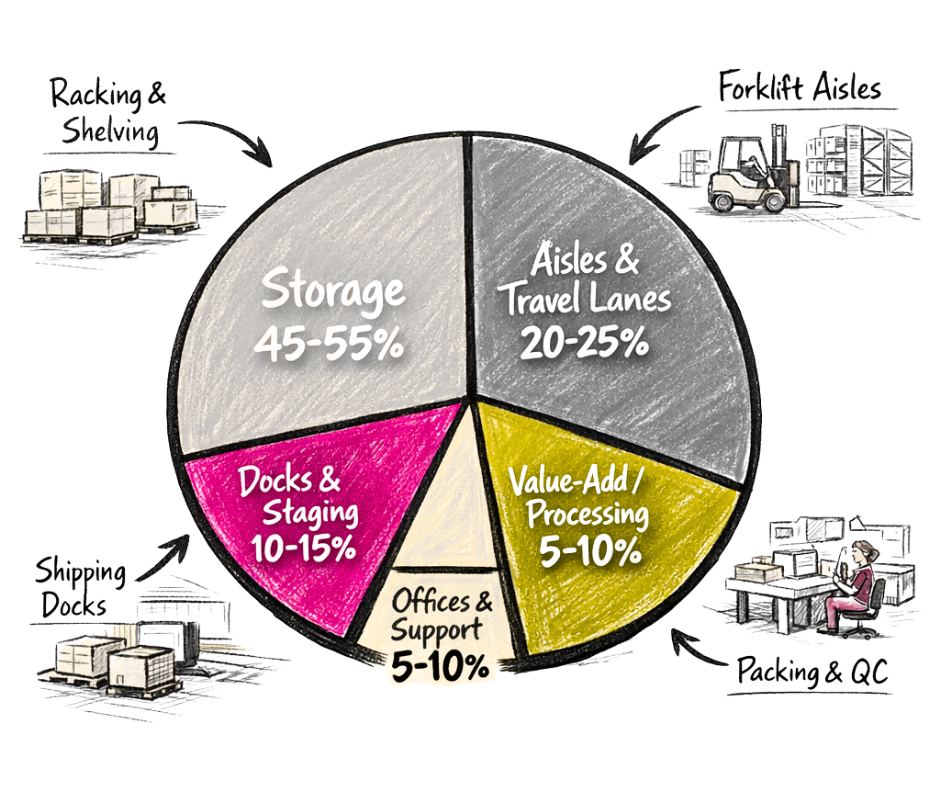 It’s wasted space. Let’s look at it:
Walk through a typical American distribution center (DC) and you’ll see what looks like a busy, full building: racks to the ceiling, forklifts moving constantly, docks humming. But when you look at how the space is actually used, a different picture appears.
On average, a DC’s floor space breaks down roughly like this:
-
Storage (racking, pallet positions, bin shelving) 45-55%
-
Aisles and travel lanes 20-25%
-
Docks and staging (shipping/receiving buffer zones) 10-15%
-
Value‑add areas (kitting, packing, QC, returns) 5-10%
-
Offices, break rooms, utilities, maintenance 5-10%
Individually, all of these are necessary. The problem is the balance between them and especially how much of the building’s volume is consumed by horizontal movement rather than actual storage or value‑add work.
Industry benchmarks often show: Many warehouses operating around 40–70% overall space utilization. Good performance in the 70–85% range. That 10 to 25% gap points of potential capacity. That’s where a lot of money is being wasted, or where a lot of savings could be made, depending on what you decide to do.
Where do DC’s waste the most space?
When operations teams look for more capacity, they often jump straight to “we need a bigger building” or “we need more racks.” Yet a lot of the underutilized space isn’t empty shelves; it’s layout‑driven waste.
Common culprits:
-
Over‑wide aisles sized for convenience, not throughput requirements.
-
Long horizontal conveyor runs and travel paths cutting through prime floor space.
-
Underused vertical cube above low mezzanines or short rack lines.
-
Fragmented flows that force product to snake across the building multiple times.
As a result, it’s not unusual for a DC to have 15–30% of its footprint functionally wasted—space that can’t be used for storage because it’s tied up in traffic lanes, conveyor spurs, or inefficient routing.
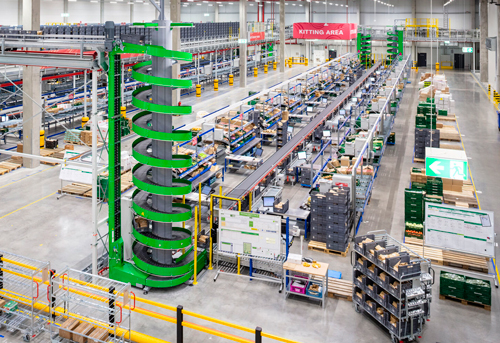 Thinking vertically: What does that mean for Warehousing?
Instead of having a traditional horizontal mindset when it comes to your warehouse or distribution center, start thinking about how the vertical space can be utilized. This gives you a lot of flexibility and expansion can happen within the current building. This saves a lot of money.
One of the most effective ways to reclaim that waste is to rethink how you move product between levels and processes.
Traditional horizontal conveyors and long forklift routes tend to consume large strips of floor space. They lock in a “flat” layout that’s hard to densify later. Using too many forklift solutions also force compromises on where you can place racks and workcells.
How vertical conveying — especially with Spiral Conveyors — flips that equation:
-
You trade long horizontal runs for tight vertical footprints.
-
Product moves up or down in a small, controlled area.
-
The aisles and zones that were once dedicated to travel can be converted into storage, value‑add, or staging.
In practice, that can help unlock part of that 15–30% wasted area by:
-
Shortening travel distances between mezzanines and ground level.
-
Allowing denser racking where conveyors used to run.
-
Freeing up clean, contiguous zones for packing, returns, or kitting.
Why this matters now
For most operators, adding new square footage is expensive and slow. Optimizing existing space, on the other hand defers or avoids building expansions and relocations. It also increases capacity without adding headcount at the same pace. Moreover it improves safety by reducing traffic conflicts and cluttered aisles.
If you can increase effective capacity by even 10–15% inside the four walls you already pay for, simply by redesigning flows and going vertical. That’s a major ROI lever!
A low‑risk, high‑impact approach
The key is to treat space as a strategic asset, not a fixed constraint:
-
Map where your current square footage goes: storage, travel, docks, offices.
-
Identify long horizontal moves and “dead zones” around conveyors and ramps.
-
Ask, “What could this space be if vertical movement was compressed into a smaller footprint?”
Ryson Spiral conveyors are one of the tools that make that shift possible, especially in retrofit or expansion‑by‑optimization projects. Instead of redesigning the entire building, you can surgically convert wasted horizontal space into vertical capacity and give that floor back to storage and value‑add operations.
If you’re ready to get more out of your space, feel free to connect to our team!